Designing for Choice: Why Neuroinclusive Design Isn't One-Size-Fits-All
One of the most interesting ideas to emerge from London Design Festival this year was not a colour, material or aesthetic trend, but something much more fundamental: choice.
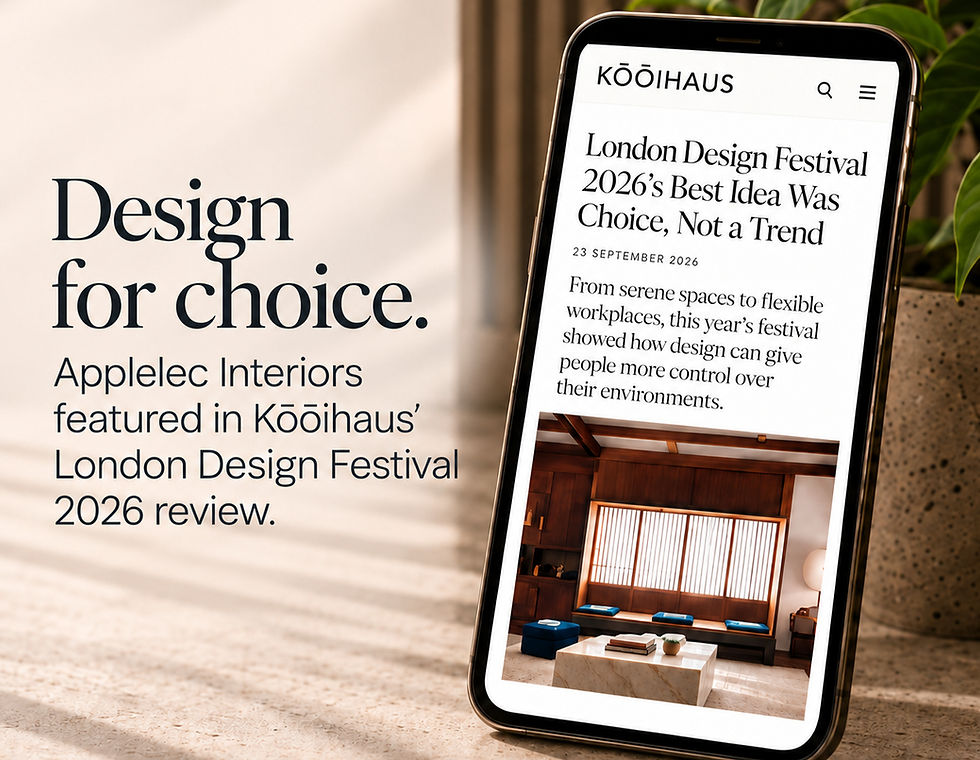
In its review of the festival, Kōōihaus highlighted Applelec Interiors as an example of how design can respond to a wider range of sensory needs, referencing integrated acoustic treatment, adaptable illumination and illuminated wayfinding.
It is an idea that sits at the heart of our Designing for Calm approach.
There is no single lighting level, colour temperature, acoustic condition or type of space that will feel right for everyone. What supports focus for one person may feel overstimulating to another, while preferences can also change according to the task, environment or time of day.
Rather than trying to create one supposedly perfect setting, we believe there is greater value in creating environments that can adapt.
At NeuroPlaces during Shoreditch Design Week, our Designing for Calm installation explored how lighting, acoustics, zoning and spatial cues can work together to create spaces that offer greater flexibility and control.
What was particularly encouraging about the Kōōihaus review was seeing this wider idea recognised independently. Its article identified choice and agency as one of the strongest themes to emerge from the festival:
“Design can give people more control over their environments.”
For us, that is an important part of neuroinclusive design.
Designing for Calm is not about prescribing what “calm” should look like. It is about creating environments that recognise different needs and give people greater choice in how those environments work for them.
Because the most inclusive space may not be the one with the perfect setting, but the one that allows people to find the setting that feels right for them. Read the full Kōōihaus article:London Design Festival 2026’s Best Idea Was Choice, Not a Trendhttps://kooihaus.com/london-design-festival-2026-home-ideas/
Explore Designing for CalmDiscover how Applelec Interiors is exploring lighting, acoustics, materials and spatial cues to support more neuroinclusive environments.