Beyond Brightness: The Science Behind Biophilic Lighting Design
From the changing rhythm of daylight to the interplay of light and shadow, a recent Journal of Biophilic Design article invites us to reconsider how illumination shapes the spaces we inhabit.
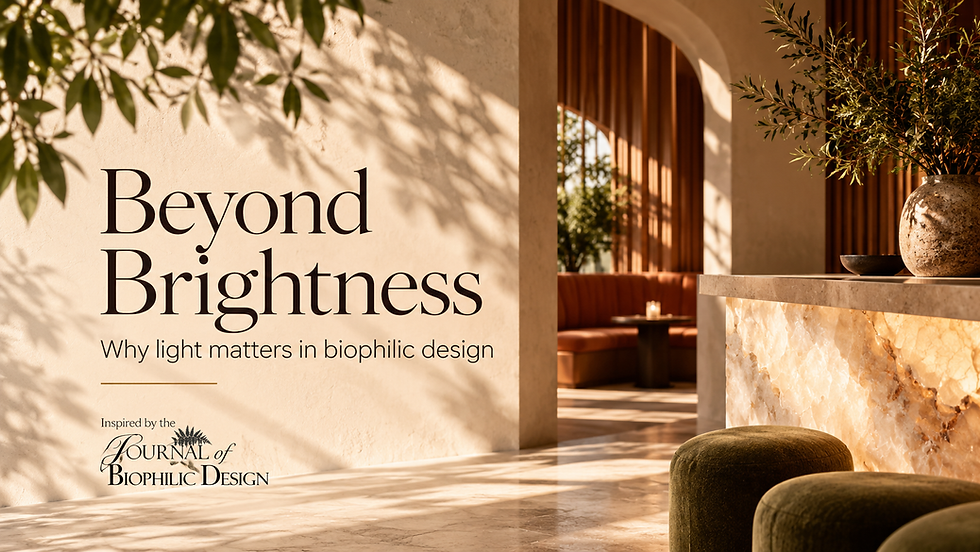
Light is one of the most familiar elements of our surroundings, yet its influence extends far beyond what we see. Throughout the day, natural light changes in intensity, colour and direction, providing important cues that help our bodies respond to the passing hours.
In The Bath, the Bins and the Biology of Light, published by the Journal of Biophilic Design, Dr Vanessa Champion explores the relationship between light, human biology and the built environment, drawing on insights from lighting specialist Dr Shelley James. The article raises an important question for interior designers: if our bodies have evolved around the changing patterns of daylight, what happens when so much of our time is spent beneath largely static artificial illumination?
How our bodies read light
Beyond the cells that enable us to see colour, shape and movement, our eyes contain specialised light-sensitive retinal cells that help communicate information about light to the brain.
Some of these cells contain a pigment called melanopsin, which plays an important role in our responses to environmental light. Through pathways involving these cells, light helps regulate our internal circadian clock — the approximately 24-hour rhythm that influences sleep, alertness and other biological processes.
This means that two spaces which appear similarly bright may not have the same biological effect. The spectrum of light, its intensity, the time of exposure and the amount reaching the eye all matter.
For interior designers, this introduces another dimension to lighting specification. Beyond how a space looks, there is value in considering how people experience light throughout the day, and how illumination might adapt to changing activities and needs.
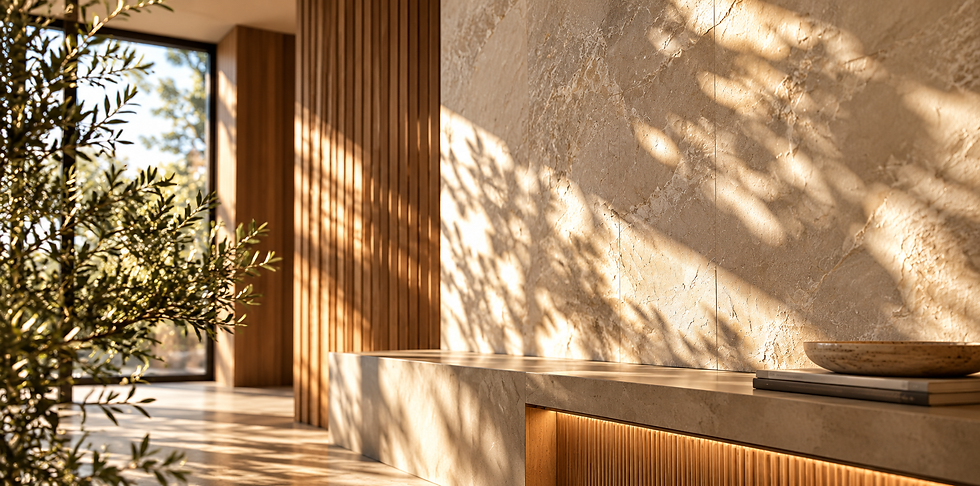
Biophilic Lighting Design: Learning from Nature
The article also offers a broader perspective on biophilic lighting design. Nature is rarely uniform. Sunlight filters through foliage, shadows move across surfaces and changing light reveals new qualities in familiar materials. These subtle variations contribute to the richness of natural environments.
For Applelec Interiors, these ideas reinforce the importance of considering light as part of the original design, rather than an addition made once the materials and architecture have been established.

Across our growing portfolio, we explore how illumination can interact with materials in different ways. LumiSorb brings together acoustic surfaces and integrated lighting, while our Parametric Walls use nature-inspired textures and carefully engineered illumination to highlight depth, form and shadow. Through our wider lighting capabilities, we are also exploring how adjustable illumination can contribute to more adaptable environments.
This thinking connects closely with our Designing for Calm approach, which recognises that comfort is not a fixed setting. Different people, activities and times of day call for different conditions, making flexibility and individual control important considerations in more inclusive spaces.
Perhaps the most valuable takeaway is that thoughtful lighting design is not necessarily about introducing more light, but understanding where, when and how it is needed — and recognising the importance of contrast, variation and darkness.
As the conversation around human-centred interiors continues to evolve, light deserves a place at the beginning of the design process.
Further Reading | Journal of Biophilic Design
This article was inspired by The Bath, the Bins and the Biology of Light, written by Dr Vanessa Champion for the Journal of Biophilic Design, featuring insights from Dr Shelley James. Read the original article — The Bath, the Bins and the Biology of Light
Explore Designing for Calm
Discover how Applelec Interiors is exploring the relationship between lighting, acoustics, materials and more adaptable, neuroinclusive environments.